Bestandskundengeschäft in HubSpot für Enterprise SaaS
Bestandskundengeschäft in HubSpot: Verlängerungen, Upsells und Cross-Sells mit einem gemeinsamen Modell für Vertrieb und Customer Success steuern.
From “Closed Won” to Flywheel: Map the Post-Sale Journey
Don’t stop at “Closed Won.” Model the full customer lifecycle so each phase is measurable and actionable.
Core stages to operationalize
- Ready for Onboarding → contract closed, kick-off scheduled, materials prepped
- Onboarding → setup, integrations, first trainings shipped
- Adoption / Activation → users live; usage and benchmarks tracked
- Impact → ROI measured, outcomes documented, expansion hypotheses captured
- Retention → QBRs, health monitoring, renewal motion in flight
- Downgrade → early-warning path for shrinking seats/usage; re-engage plans
- Expansion → upsell/cross-sell scoped, business case approved
- Renewed → extension booked, value narrative reinforced
- Churned → clean offboarding, reasons captured for learning loops
Pro tip: keep these stages distinct from your new-business pipeline. Existing Business is its own pipeline with post-sale probabilities and stage-gates.
How to Configure the Existing Business Pipeline in HubSpot (10 Minutes to “V1”)
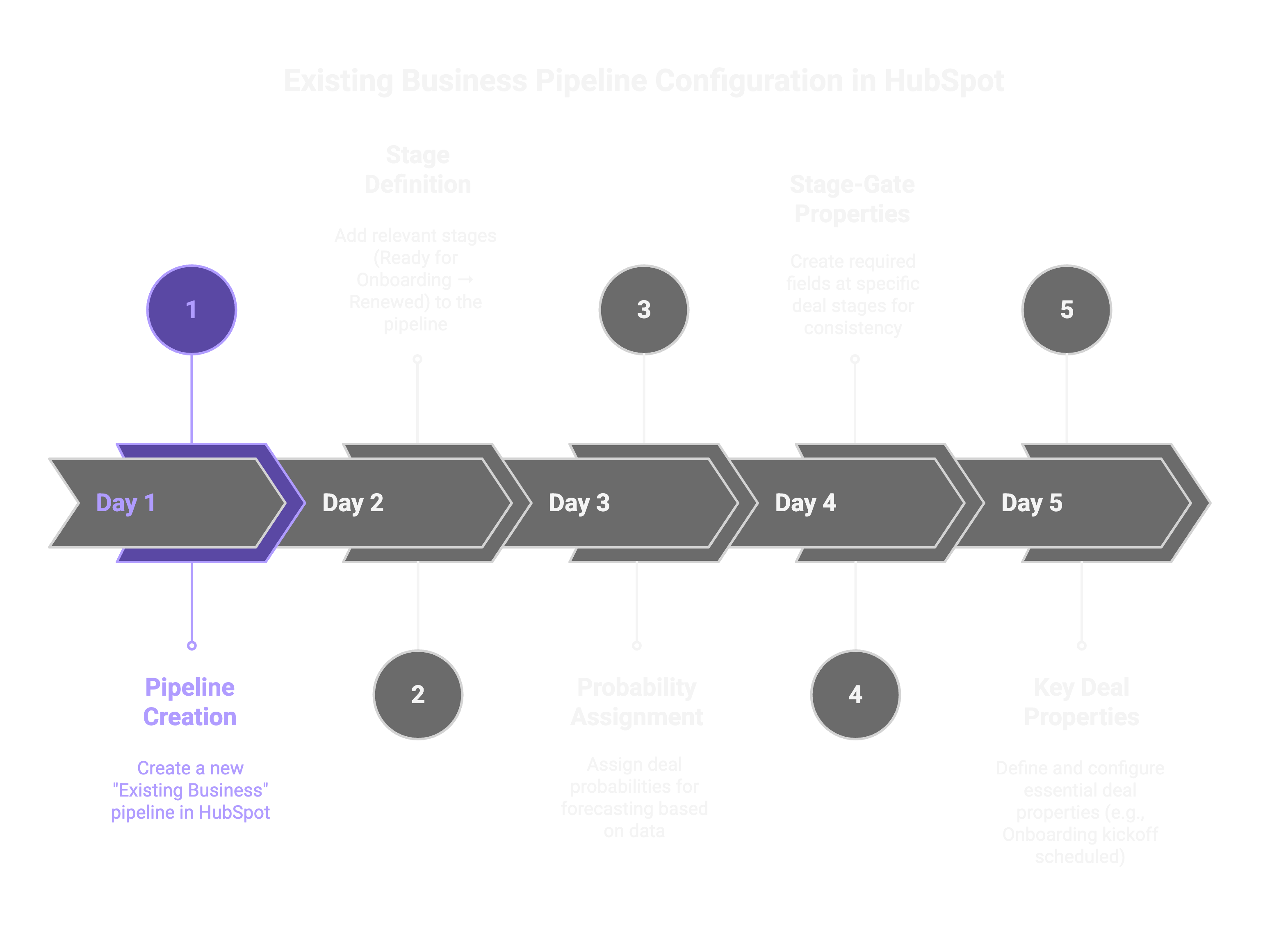
- Create the pipeline: Settings → Objects → Deals → Pipelines → Existing Business.
- Add stages & probabilities: e.g., Onboarding (10%), Impact (50%), Expansion (80%), Renewed (100%).
- Enforce stage-gates with required properties (so every deal advances on facts, not vibes):
- Onboarding kickoff scheduled (date)
- Technical setup completed (checkbox)
- Baseline training completed (checkbox)
- Live in production (checkbox)
- Engagement threshold met (number)
- ROI measured & documented (checkbox)
- Business review scheduled (date)
- Expansion opportunity identified (checkbox)
- Renewal discussion scheduled (date)
- Churn prevention measures implemented (checkbox)
- Customer feedback collected (checkbox) / Churn reason (multi-select)
Automation That Removes Friction (and Missed Handovers)
Use Workflows to keep momentum from Sales to CS and back again.
- Auto-create the CS deal: When a New Business deal hits Closed Won, spawn an Existing Business deal, set the CS owner, and attach the account plan.
- Onboarding task pack: Kick off a task queue (deck, integrations, training schedule) the moment “Ready for Onboarding” is set.
- Customer comms: Send welcome emails with the link to the onboarding portal or intake form.
- Health & renewal timers:
- Time delays to nudge renewals (T-120/T-60/T-30).
- If/then alerts when engagement falls below your baseline.
- Expansion watch: When ROI documented = yes and engagement ≥ threshold, notify AE/CSM and create an Expansion discovery task.
Sales Hub: Build the Expansion Muscle
Give teams the tools to drive—and document—value:
- Playbooks: Templates for QBRs, ROI narratives, and upsell discovery.
- Tasks & Sequences: Check-ins N days after go-live; reminders to review usage, adoption, and stakeholder threading.
- Custom properties for readiness:
- User engagement score
- CSAT/NPS/CES
- Feature adoption rate
- Advocacy status (reference ready)
- Root-cause analysis status (when usage dips)
- Re-engagement & ROI reinforcement plans captured

Service Hub: Retain What You’ve Won
Layer Service Hub for scalable retention and early risk detection.
- Tickets & SLAs: Operational guardrails for support and customer requests.
- Feedback surveys (NPS/CSAT): Predict intent and trigger save motions.
- Knowledge base & customer portal: Self-service that reduces time-to-value and increases transparency on renewals and tickets.
Dashboards That Leadership Actually Uses
Track a handful of metrics that correlate with revenue outcomes:
- Expansion Rate – % of customers with upsell/cross-sell in period
- Renewal Rate – % of customers renewed in period
- Churn Rate – % of customers lost
- Time to Expand – avg. days from onboarding → first expansion
- Customer Health Score – composite of NPS/CSAT + engagement
- ROI Realization Rate – % of customers with ROI field completed
Build one Existing Business dashboard per audience (Exec, CS, Sales) and gate your KPIs to the stage-gates above—what gets measured gets managed.
Governance: Keep Data (and Behavior) Clean
- One pipeline per motion (New vs. Existing Business).
- Mandatory stage-exits: don’t advance without the required facts.
- Auto-logging & naming conventions for notes, QBRs, and ROI docs.
- Weekly ABR (Account Business Review): 30 minutes to scan stage movement, risks, and expansion next steps.
Quick-Start Checklist (Print This)
- Existing Business pipeline created with stages & probabilities
- Stage-gates (required properties) configured
- Closed-Won → CS deal workflow live
- Onboarding task pack + welcome email live
- Health alerts + renewal timers configured
- QBR/ROI playbooks published
- Exec/CS/Sales dashboards shipped
Common Pitfalls (and How to Avoid Them)
- Treating Existing Business like “just another stage.”
Fix: give it a separate pipeline, metrics, and owners. - Advancing stages without artifacts.
Fix: enforce required properties and attach docs (QBR, ROI). - Renewal “surprises.”
Fix: auto-create renewal deals at T-120, with tasks & sequences. - Expansion as a lucky break.
Fix: tie alerts to engagement + ROI; log hypotheses and next steps.
The Payoff
Operationalizing Existing Business in HubSpot shifts your revenue story from one-off wins to a measurable, expandable relationship with every customer. Sales keeps context, CS proves impact, leadership gets reliable forward indicators—and your board sees compounding NRR instead of one-time heroics. Start simple, enforce the gates, and let the flywheel spin.
Häufig gestellte Fragen
Gehört das Bestandskundengeschäft in dieselbe Pipeline wie das Neugeschäft?
Welche Phasen gehören in eine Existing-Business-Pipeline?
Wie verhindert man, dass Deals ohne Faktenlage weiterrücken?
Ein kostenloses 60-Minuten-Launchpad klärt, welcher Hebel zuerst greift. Kein Pitch, ehrliche Einschätzung, ob es passt und klarer nächster Schritt.